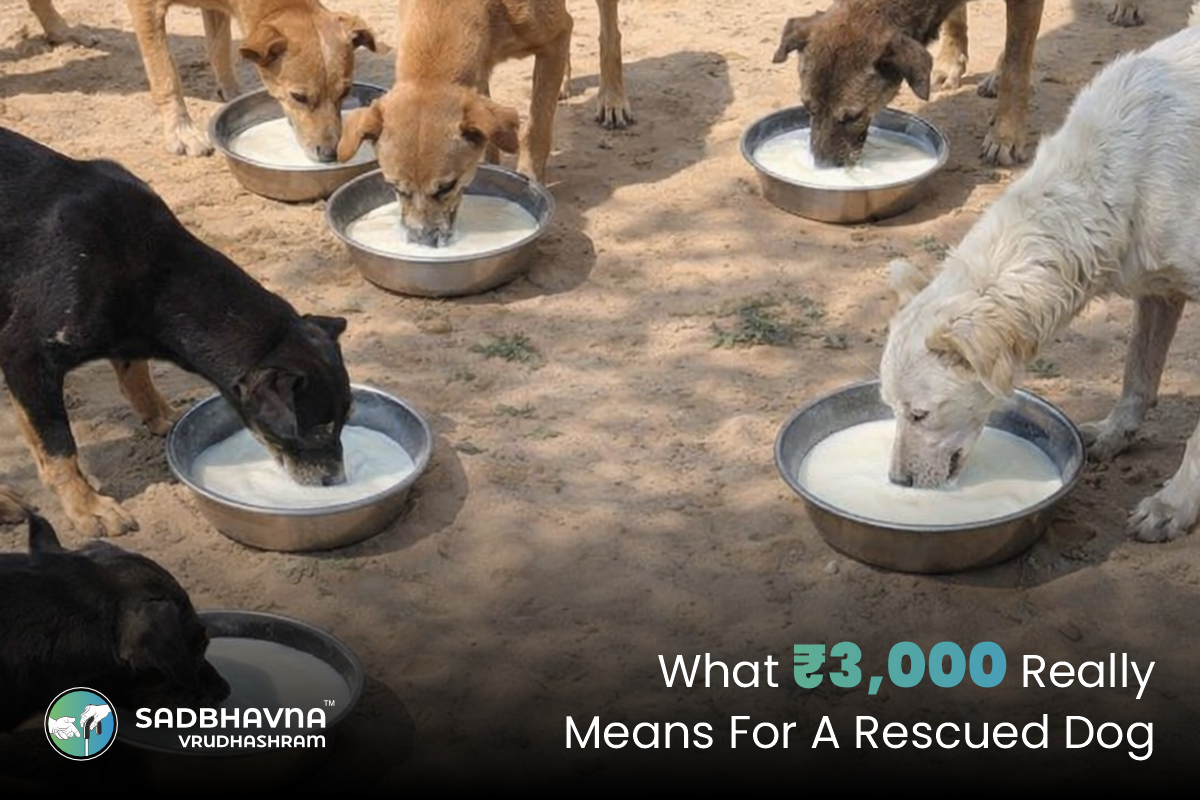
She had no name yet. She was devoid of a collar, of an owner, of one to grieve at her anywhere in the world. Instead, she had a wound on her hind right leg, which had been left untended for weeks, the ribcage which was seen in the matted fur, and eyes that had already learnt not to hope that kindness was forthcoming.
On a Tuesday morning, she was discovered by a volunteer with a small animal rescue in Rajkot in a construction site. She was too weak to run away. Probably that was the only reason why she survived.
The volunteer took her to a clinic in a cardboard box (borrowed) to carry her. The vet looked at her without saying anything, made a list on a small piece of paper, and pushed it over the table. The total came to ₹ 3,200.
The volunteer had ₹ 3,000 in her purse.
At that time three thousand rupees was no figure. It was the life and death of a dog.
What the Rupees Actually Buy
We talk of donations in rounded numbers since rounded numbers are simple to tell and easy to remember. But we had better pause and examine, per item, what ₹ 3,000 does to the body of a rescued dog on the street, and possibly to her soul as well.
Vaccinations are always the initial spending. To a dog that has lived on the streets, the world is a book of the unseen dangers: canine distemper, parvovirus, leptospirosis, rabies. These are diseases, which do not come without a warning. In isolated cases, parvovirus is able to claim a dog in less than 48 hours of having the symptoms, by mercilessly vomiting and blood-laden diarrhoea. Costs of a complete course of essential vaccines range between ₹ 600 and ₹ 900 – a petite sum to pay to have what is essentially armour against a dozen separate causes of death.
The second step is deworming and treating ticks. This is the aspect that people forget since it is not glamorous. But parasites are patient. They nest inside a system of a malnourished dog and silently feed off whatever nutritional resources it has been able to locate. One dose of a broad spectrum dewormer will cost less than ₹ 100. An entire course of anti-ticks costs ₹ 150 to ₹ 300. They may together extend by months – even by years – the useful life of an animal.
Then there is wound care. Street dogs bear their wounds in the manner in which urban sidewalks bear cracks – everywhere, silently, building up. Road rash, bitten by fights over the territory, infected feet during a walk through broken glass and industrial wastes. Cleaning, debridement, antibiotics, and bandaging on an intermediate wound costs ₹ 300 to ₹ 600. In the case of something as simple as an unattended cut, a difference between 300 spent and 300 withheld can be the difference between a leg healed and an amputated leg.
Finally, food. Not a luxury – medicine. A dog that is severely malnourished is unable to absorb nutrients effectively, is unable to heal tissue, is unable to combat infection. Three weeks of healthy food, which is boiled chicken, rice, and a simple kibble supplement, will cost ₹ 800- ₹ 1,200. And there is the window where the body of a starving dog recovers what it was like to be a body.
A month of restaurant expenses for a middle-class family is ₹ 3000. To a dog in the street, it is the whole architecture of life.
The Dog Who Has Nothing
When we refer to street dogs in India, we are referring to roughly 35 million animals – the greatest stray dog race on the planet. The majority of them did not get born freely. They are the kids of pets that have been let down, of a dog that people have purchased on a whim and dumped when they became inconvenient, of working dogs whose owner relocated. They live in a city that was not built to accommodate them, food that was not prepared to be handed to them, and diseases that nobody intended to hand to them.
They are not wild. That is what people miss. A street dog who has come to be approached by a volunteer, who hides her head and lets someone touch her sore leg, is not a wild animal who has accepted to be captured. That is a domesticated animal, which has been kept for ten millennia to trust in humans, and which, despite the many times that it is betrayed, and when it is betrayed, still, most unlikely, gives it one more time.
That faith to believe–weak, obstinate, heart-shattering, is the stuff ₹ 3,000 has to operate on. It is not only meting out costs on vaccines and food. It covers a body that is able to shake a tail. It compensates for the time in which a dog that never received a name hears that she is being called by name, and something good is likely to follow.
The Weight of a Small Amount
India has rescue workers who will say ₹ 3,000 is everything and nothing. All, since it includes a first-rescue package of one dog. Nothing, due to the ten more dogs at the gate, and the rescue fund was exhausted on Thursday.
The small animal rescues in India work pretty much on donations by individuals, volunteer labor and a special form of persistent love that does not say whether the game is worth the candles. The majority of them are not funded by the government. Numerous ones do not have permanent locations. They organize through WhatsApp calls at 2 a.m. and transport injured animals themselves, use personal credit cards to cover veterinary bills, and raise money by posting on Instagram, which the majority of people scroll through.
The numbers of rescues are harsh. A single spay operation which helps a female dog to have only two litters annually with six or eight puppies each costs 1,500 to 3000. One surgery. One dog. A single choice that can annul the pain of the future of maybe fifty animals who were never unfortunate to be born. It is the most effective spending on the welfare of animals, and the majority of rescuers are not able to afford to do it on a regular basis.
Every ₹3,000 that finds its way to a rescue is a calculation made in someone’s favour.
Her Name Was Eventually ‘Mira’
The volunteer paid ₹3,000. She borrowed the remaining ₹200 from the clinic’s petty cash, a quiet kindness the vet never mentioned again.
Mira the name came later, from the volunteer’s daughter, who said she looked like she had survived something epic, like the poet Mirabai spent three weeks in a foster home. She ate. She slept seventeen hours a day. She allowed, then sought, then demanded physical affection with the confidence of an animal who has decided that safety is real.
She was adopted four months later by a family in Ahmedabad. The woman who adopted her sends photographs on Sundays. Mira sleeps on a blue blanket. She has toys she has partially destroyed. She has learned, apparently, that the sound of a refrigerator opening is cause for immediate optimism.
She does not know what ₹3,000 means. She does not know that her survival was a financial transaction, or that it was nearly impossible, or that a woman she will never remember reached into her purse and found almost enough.
She only knows what she has learned since: that the world contains warmth, and that she is allowed inside it.


