


How a Japanese Technique and Gujarat’s NGOs Are Building Forests That Actually Survive
Introduction
Walk though Rajkot in may and hit it. Satellite data record land surface temperature consistently above 42c in the city’s hotspot areas, industrial clusters, traffic junctions, and zones without any tree canopy. Ahmedabad hit 45.C in May 2025, with nights barely cooling below 31C. Gujarat, India’s largest industrial engine, has paid an ecological price for its growth: a total; forest cover of just 15,061.64 s1 km, only 7.65% the states of geographical area, according to India state’s of forest report.
The crisis is not abstract. In 2023, Gujarat lost 36.39 sq. Km. Of mangrove cover – the highest mangrove loss of any state in India, according to ISFR 2023. The 2010 Ahmedabad heatwave caused 1,344 excess deaths in May alone – a figure that prompted the city to release South Asia’s first Heat Action Plan. Rajkot has formally adopted India’s first Urban Cooling Action Plan. The question is no longer whether Gujarat has an ecological problem. The question is what works.
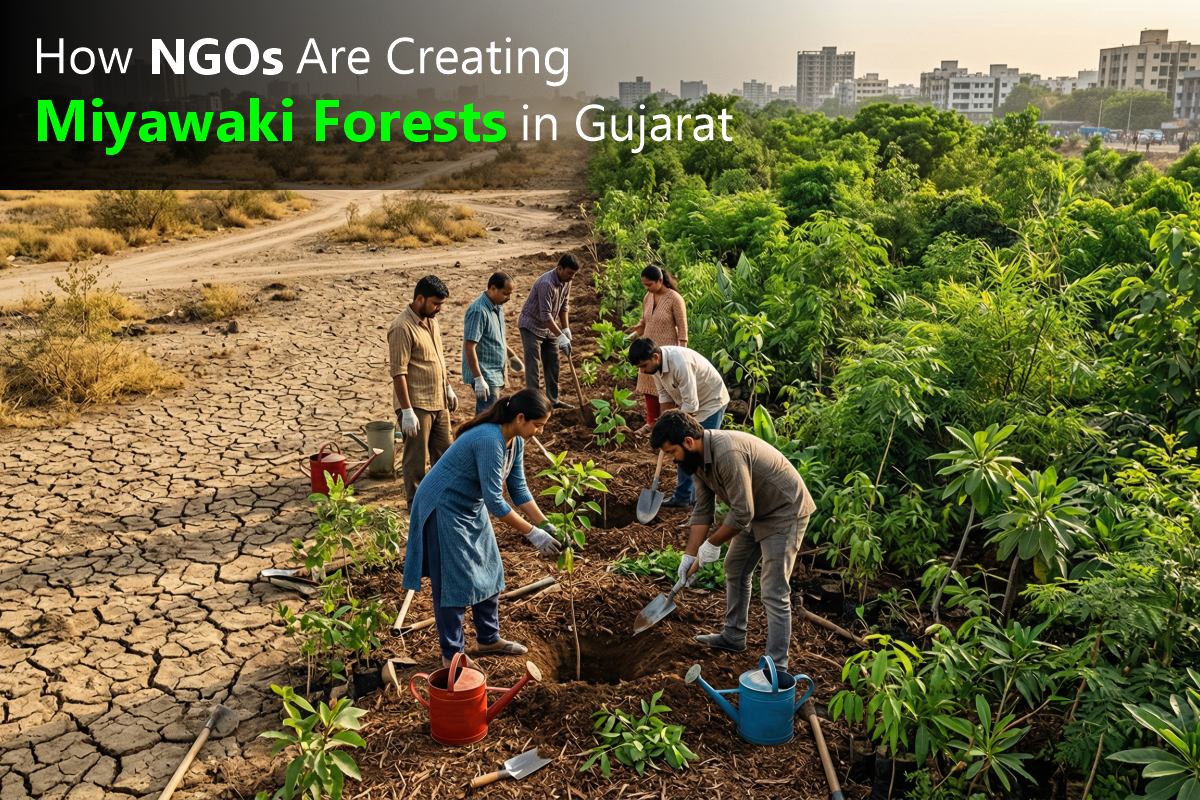
The answer gaining momentum across the state is the Miyawaki method – a Japanese afforestation technique that builds dense, self-sustaining, multi-species native forests in a fraction of the time it takes nature unassisted. Backed by government policy (the Van Kavach programme), corporate CSR funding, and a network of dedicated NGOs, Miyawaki forests are appearing on Ahmedabad’s lakesides, in Kutch’s harsh desert terrain, along Valsad’s coast, and on a Gandhinagar dumping site. This article explains the science, documents the real projects already underway, and profiles the organisations making it happen – with verified data so you can get involved.
What Is the Miyawaki Method? The Science Explained
The Miyawaki method was developed by Japanese botanist Dr. Akira Miyawaki in the 1970s, inspired by his research into potential natural vegetation (PNV) – the plant community that a given location would naturally support without human interference. Miyawaki spent years studying sacred shrine forests in Japan – tiny remnants of natural forest that had survived intact for centuries – and used those as a blueprint for artificial regeneration.
The core insight was radical: a planted forest can become a self-sustaining, high-diversity ecosystem not in centuries, but in decades – if the right species are planted together, at the right density, in properly prepared soil.
The 5-Step Process
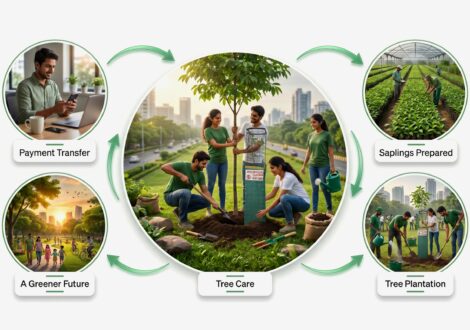
- Step 1: Check the site’s soil type, drainage and sunlight.
- Step 2: Choose 111+ indigenous species suited to the local climate.
- Step 3: Enrich the soil with compost and organic matter before planting.
- Step 4: “Planting at a distance of 2*2 feet.
- Step 5: Water and maintain for only 3 years.
- Step 6: After 3 years, the forest is self-sustaining forever.
Why It Outperforms Conventional Plantations
| Feature | Conventional Plantation | Miyawaki Forest |
| Species count | 1–2 species | 20–50+ native species |
| Planting density | 1–2 trees/sq.m | 3–5 saplings/sq.m |
| Forest structure | Single canopy layer | 4 layers: canopy to ground cover |
| Growth speed | Standard | Up to 10× faster |
| Self-sustaining? | Needs ongoing care | Yes — after 3 years |
| Biodiversity | Low | High — birds, insects, small mammals |
| Time to maturity | 30–50 years | 5–10 years for dense canopy |
| Survival rate | Often poor | High once established |
A case study of Ahmedabad Sabarmati oxygen’s park was published in the ISRO journal of environmental science 2023 and indicated that the miyawaki methodology implemented in the semi-arid conditions of Ahmedabad proved successful in improving ecological functioning, boosting biodiversity and increasing carbon capture. The trees are expected to grow around 1 meter per year in the first few years, up to 18 meters within 20 years.
According to the ISFR 2023, the total forest cover in Gujarat is 15,016.64 sq. Km, making it 7.65% of the geographical area of the state. Of this only 419.71 sq. Km(0.21%) are Very Dense Forests, 4,902 sq. Km are Moderately Dense Forests and 9,694 sq. Km are Open Forests, the most vulnerable type. While the good news is that the state records the highest increase in forest cover outside Recorded Forest Areas among all states (+241.29 sq. Km) and the second highest overall increase (+180 sq. Km) after Mizoram. At only 7.65% it is far from the national aspiration of 33%.
The Mangrove emergency.
The coastal data is unambiguous; total mangrove cover of India is 4,991 sq. Km and since 2021, mangrove cover across the nation has reduced by 7.43 sq. Km, of which 36.39 sq. Km of a remarkable decline was from Gujarat. Gujarat’s mangrove cover has diminished by 36.39 sq. Km since 2021 which was the highest reduction in the country over that period. The reduction in the mangroves will be detrimental to the protection of the coast from cyclones, carbon sequestration potential and marine nurseries, on which the livelihood of the fishing communities of Gujarat depends heavily.
Urban heat-a medical emergency.
The deadly heat wave in Ahmedabad in 2010 which recorded temperatures of 46.8 ° C, and led to 1,344 excess deaths in May, the city produced South Asia’s first Heat Action Plan. The 2024 heat wave has recorded 430 deaths across India between April to July. The city of Rajkot, with over 43,000 small-scale industrial units spread over an area of 170 sq. Km., registers land surface temperature among the highest in the country with hotspot zones of 50 degrees in May.
Here are some actual Miyawaki projects that have been implemented in Gujarat.
1. Nargol Coastal Forest, Valsad – World’s Largest Coastal Miyawaki Forest
Situated in the Nargol village, Umargam taluka, Valsad district, South Gujarat. The Enviro-Creators Foundation (Forest Creators) under the leadership of Dr. R. K. Nair and Dipen Jain have built what has been documented as the world’s largest coastal Miyawaki forest. It has 1, 20,000 plus native trees with approximately 27 days to build it. It was built on the coast where the saline soil and the constant sea winds almost make planting conventional ways of planting difficult and impossible. Post-construction of the forest exotic birds can now be found in this region and a Biodiversity Hotspot has been formed with the local coastal species of nesting habitat. It was established and showed that this can be built in a saline environment with challenging extreme coastal conditions where none of the afforestation experts could ever imagine planting any sapling.
2. Chhani Lake Urban Forest, Vadodara
Located along Chhani lake, Vadodara city. An ICLEI South Asia CapaCITIES project; it is a 900 sq meter and 3000 plus trees spanning over 38 different native species in the vicinity of Chhani Lake Vadodara and stands as a best-documented Miyawaki urban plantation in Gujarat providing a tangible baseline of urban ecosystem recovery within a congested metropolitan setting.
3. Kolvada Dumping Site, Gandhinagar – From waste to forest
Situated in Kolvada, Gandhinagar district. The Forest Department Gandhinagar converted the site of waste dumping over a period of 4 years in a working Miyawaki forest, planted 50,000 odd trees and another 50,000 on top and on the premises of the dumping site and introduced benches along with the pathway making it accessible. Some trees planted include Banyan, Arjun, Umbro, Mahudo, Karanj, Rayan and a few medicinal plants.
4. Grasim Van, Bharuch – Corporate Miyawaki on a large scale.
Located in Bharuch industrial district. Grasim Industries with the help of Dr. R. K. Nair has built a Miyawaki forest on two acres of land in Bharuch, on which 68,000+ trees covering more than 80 species of trees, shrubs, ground plants were planted and on top of that some women were employed for the same which is giving employment too.
5. Sadvichar Parivar, Shertha, Ahmedabad – From Earth day to Environment day
Situated in Shertha, Ahmedabad district. Landmark Group planted a Miyawaki forest on their premises of a special-abled school in two months’ timeline from 22 nd April (Earth day) to 5 th June (Environment day) 2024 employees along with their staff planted the trees which gives two purpose at one time, giving respect to the environment while building employment for the specially-abled school at special-abled school which makes it a noble deed.
6. Van Kavach – Gujarat State’s Own Program across state
The Government of Gujarat formally brought this state level implementation in the name of Van Kavach (Green Shield). By 2023-24 Van Kavach has implemented 100 hectare over 85 locations throughout the state, for the year 2024-25, 200 hectare over 122 locations will be used and the total 400 hectare across 122 locations for 2025-26 has been proposed. The methodology planted 10000 native seedlings in one hectare each at a distance of 1m x 1m. Since these seedlings are planted together they compete for sunlight and hence establish faster and soon develop thick canopy thereby preventing the spread of weeds and conserving moisture in soil. From last assembly session data 5.29 lakh out of 6.47 lakh saplings survived which implies an 82% survival rate and compares with 10 to 15% in conventional forestry drives.
The NGOs spearheading the movement in Gujarat:
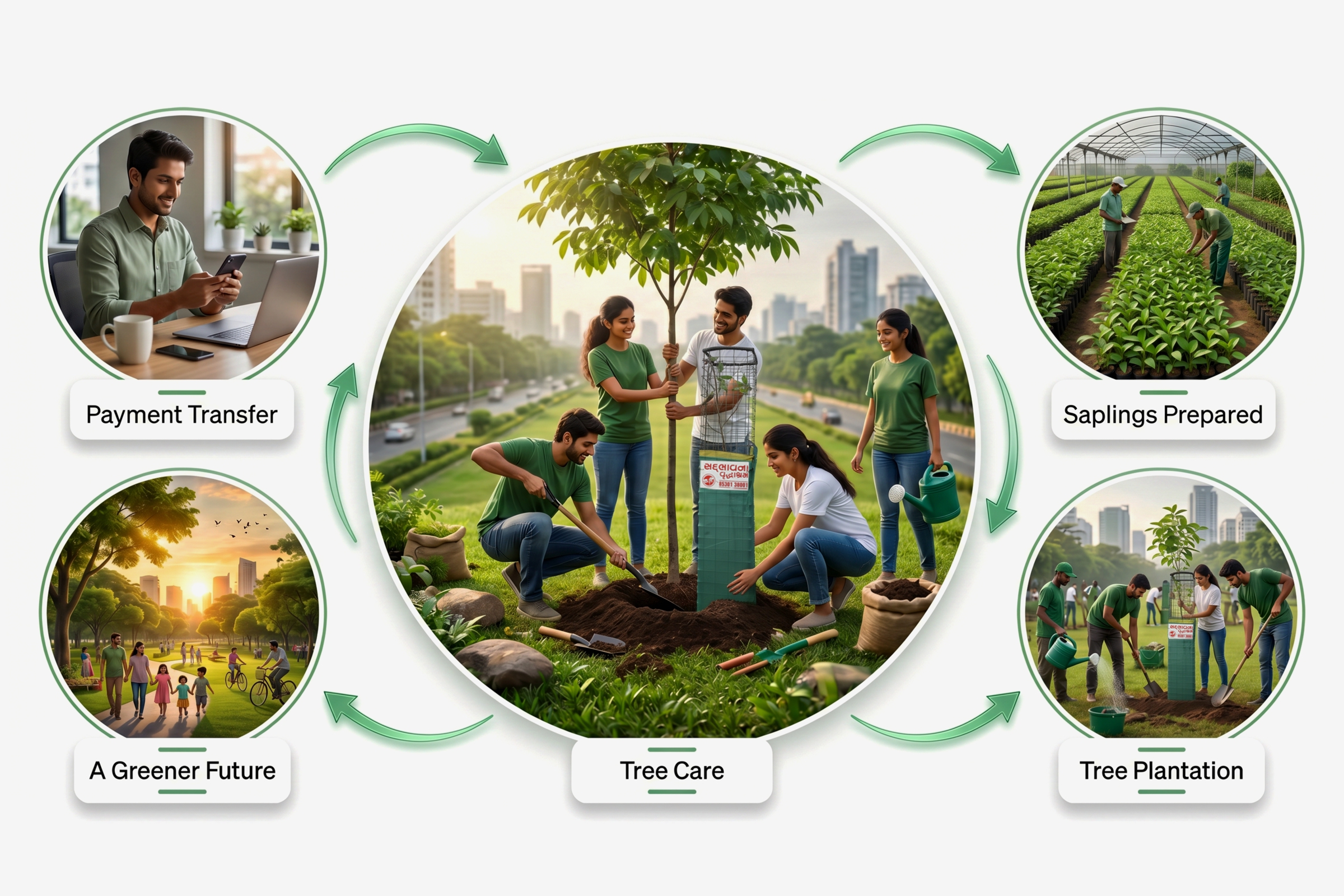
Sadbhavna Vruddhashram-Where care for elders becomes caring for nature: Sadbhavna Vruddhashram Rajkot conducts drives in rural areas in Saurashtra which involves elders and community members using local species, acceptingCSR partnership, branded drives and CSR projects.
Paryavaran Mitra – Greenening 15 cities: Paryavaran Mitra Ahmedabad runs the Vriksha Vandana program and aims to cover 15 cities of Gujarat, with indigenous species, neem, peepal, banyan, Gulmohar, making citizens tree guardians. This is to prevent post planting abandonment.
Sahjeevan – For land and livelihoods: In Kutch-Saurashtra, an arid land region with pastoral communities, they are restoring land, planting hardy native species which are drought resistant and also looking after livelihood of the community, working in more than 500 acres till date making it a long-term initiative.
Gujarat Ecology Society (GES) – For science, policy, and students:GES has joined hands with Gujarat forest dept on various planned afforestation drives and runs a Green School Program reaching to more than 2 lakh students state-wide making kids understand the importance of conservation and also possess an in-depth research function unlike other NGOs.
Aarohan Gujarat-Coastal restoration: Given that Gujarat lost its maximum mangrove forest in the last two years, Aarohan Gujarat focuses on its conservation in Gulf of Khambhat and Kori creek planting more than 80,000 mangrove saplings. Mangrove forests have Carbon sequestration capacity up to 3-5 times higher per hectare than tropical forests.
Gujarat Vanmahotsav Foundation – GPS-tracked planting for credibility: It acts as a bridge between Corporate CSR and a drive in a proper transparent mechanism by giving you real-time data of each sapling planted, tagged, photographed so as to keep you updated of it.
Viksat (Nehru Foundation for Development)– Over 30 years in tribal forests: This NGO has been working since decades in the tribal areas of Gujarat, specifically South Gujarat – Dang, Narmada and Tapi by working closely with tribals and women’s self help groups using various tree planting programs along with soil and water conservation works.
Challenges that need a realistic response from the Movement
Land Scarcity – Urban centers in Gujarat are characterized by land scarcity and complicated land-owning laws. Finding just 500 sq. Metres to develop in Ahmedabad, Surat, or Rajkot entails dealing with city corporations, revenue offices, and often private owners. The Van Kavach programme contributes by allotting public lands but suitable lands are finite.
Native Sapling Availability – Commercial nurseries in Gujarat exclusively offer ornamental and exotic species. Sourcing 20-50 different native species for large-scale planting is possible through specialized nursery development or integrated supply chains that small NGOs are often unable to manage. Incorrect tree species can turn Miyawaki planting into a conventional dense planting yielding insignificant environmental benefits.
Shortcomings in Technical Knowledge – The methodology requires precise implementation. Soil preparation and species composition are not suggestions, but are the principles which kickstart the forest dynamic. As this approach expands throughout Gujarat, quality control of technical aspects of plantation become paramount. Poorly trained people result in plantations that appear to be Miyawaki forests, but lack the functional dynamics of the same.
Multi-Year Funding Streams – The initial phase (years 1-3) is water- and weed-intensive. Corporate CSR programs typically focus on a single year, making longer-term investment planning somewhat awkward. NGOs such as Sahjeevan and Viksat that have tackled this rely on diversified funding streams: corporate CSR, individual donors, and state grants.
Long-term Data and Monitoring – Barring a few projects documented by academics, long-term survival rates and biodiversity data from Miyawaki plantations in Gujarat is insufficient. Policy recommendations to increase government funding for this endeavor are based on evidence, most NGOs simply lack capacity to maintain stringent monitoring systems post-planting.
How you can contribute
To individuals:
- Donate to any of the organizations listed above; they are authorized to accept donations and offer tax benefits under Section 80G.
- Volunteer for tree plantation activities organized by Paryavaran Mitra, Sadbhavna Vruddhashram or the Gujarat Vanmahotsav Foundation.
- Create a mini-Miyawaki at home: even a small school garden or residential society ground of 100 sq. Metres can support 300-500 saplings from 15-20 different native species.
- Urge your municipal body to include native trees in governmental planting projects.
To schools:
Contact the Gujarat Ecology Society to inquire about their Green Schools Program.
A Miyawaki forest on 200 sq. Metres in a school garden becomes an active learning site for ecology and soil sciences; observing biodiversity and taking part in planting and monitoring its growth becomes part of the school routine.
Host annual plantation drives at school for students to nurture and document the trees they have planted.
To businesses (CSR):
- Collaborate with the Gujarat Vanmahotsav Foundation for tracked, reportable CSR plantation projects.
- Reach out to Sadbhavna Vruddhashram (Rajkot) or the Enviro-Creators Foundation for their CSR plantation services.
- A properly implemented Miyawaki plantation of 1,000 sq. Metres can be facilitated within the bounds of an annual CSR budget.
- Request a formal agreement from your chosen partner stating that the CSR plantations will have GPS tagging, photographic evidence of their progress, and an annual report on their survival rate; such terms are considered standard practice for credible environmental CSR programs now.
Conclusion: A Japanese Model as a Gujarat Bet
The fundamental concept of a Miyawaki forest is an assumption about the innate capacity of nature. Once you prepare the soil correctly and plant a mix of native species much denser than typical plantations would allow, water the seedlings for their first few years, and then allow nature to take over. The intense competition among saplings for light will result in vigorous vertical growth, which is much more rapid than in standard forestry. The canopy will eventually close, and leaf litter will accumulate, forming humus and enriching the soil. Birds will be attracted, and the soil’s ecosystem will reactivate.
For a state like Gujarat that has achieved exceptional economic success and is now beginning to accept its ecological shortcomings, the Miyawaki technique is not a panacea but is effective. There are undoubtedly significant challenges. However, the examples of the Nargol world-record coastal forest, the Vadodara lakeside grove, Gandhinagar’s dumped land regeneration, and Bharuch’s corporate planting effort confirm its ability to deliver on a massive scale in Gujarat’s climate.
The inclusion of 400 hectares under the state’s Van Kavach program alone for 2025-26 signifies that policy is increasingly aligned with the available evidence. The NGOs highlighted above are instrumental in ensuring the practical implementation of these scaled efforts.
The true question for Gujarat, given its 7.65% forest cover, 36 sq. With km. mangrove depletion and city temperatures routinely exceeding 45 °C, the questionis whether it can afford not to undertake such planting initiatives.