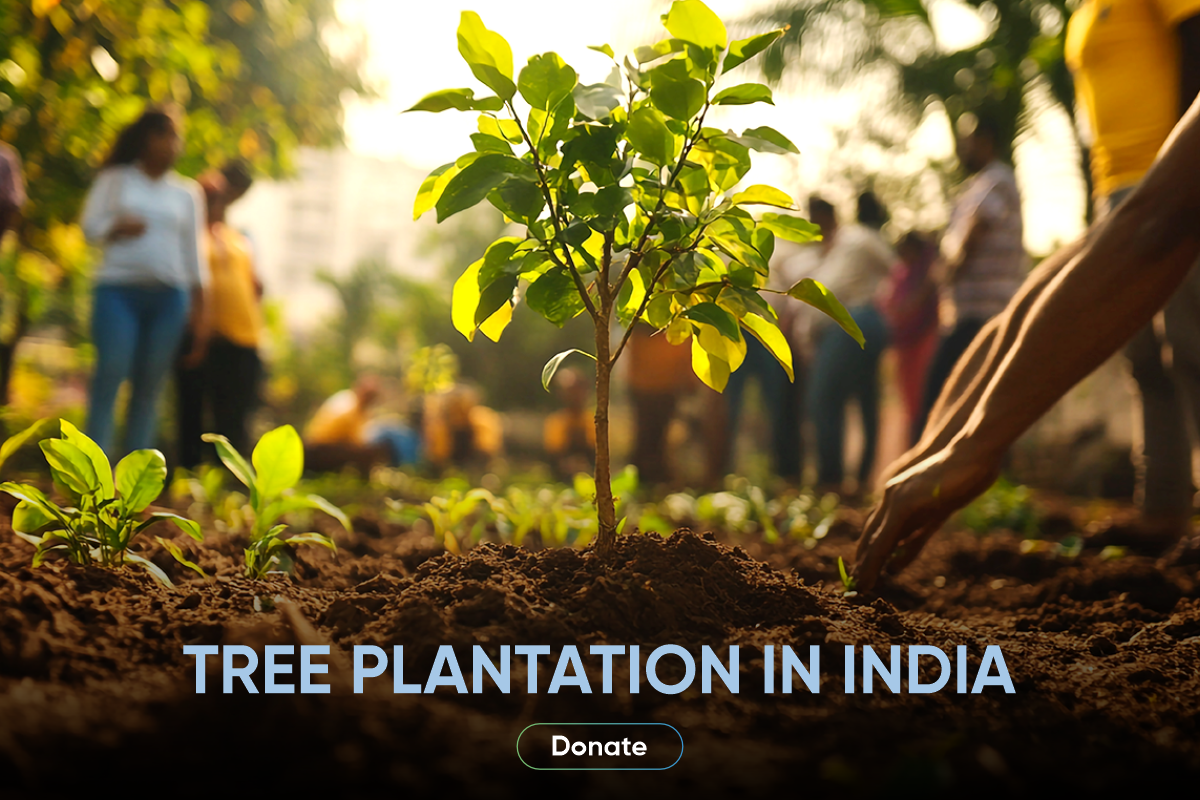
If you stepped outside even for five minutes last summer, you could feel the heat, the roads used to shimmer by noon. Even moving out in such conditions felt difficult. The problem is that we cut faster than we grew, and in order to reverse the harm done, Sadbhavana Vruddhashram has started a tree plantation drive. They have undertaken this drive to plant 151 crore trees nation-wide and when you choose to donate for tree plantation in India, you are not simply contributing to a cause. You are correcting a small part of that imbalance. You are deciding that growth should replace loss.
At Sadbhavana, plantation drives are not about ceremonial photos or one-day campaigns; they are about building something that will stand years after the moment has passed. Today, more than 11 million trees stand across different regions because someone believed planting was only the beginning. Behind those trees are real systems with over 500 water tankers and tractors working in villages, and more than 3,000 salaried employees dedicated to plantation, irrigation, and maintenance. This is not a seasonal activity; it is ongoing stewardship
Why Trees Still Matter
It’s easy to reduce trees to environmental jargon: carbon absorption, oxygen balance, biodiversity. But strip away the technical language and think about daily life.
A tree means:
- A cooler walk home for a schoolchild
- A farmer’s soil that does not wash away in heavy rain
- A roadside that feels breathable, not suffocating
- A place where birds return instead of disappear
A simple tree plantation donation may look small on paper. But over time, it becomes shade, protection, and sometimes even income if fruit-bearing varieties are planted. The impact is practical, tangible and powerful.
The Ground Reality in India
Urban expansion continues, open land becomes concrete, villages that once had natural green buffers now struggle with soil erosion and falling groundwater levels, heat waves are more intense and the air quality in cities continues to worry families. As a responsible tree plantation NGO in India, Sadbhavana does not treat plantation as a symbolic act, for us location matters, species matter and survival rate matters too.
Planting is only the first step.
Saplings are chosen based on the local ecosystem. Native species are prioritized because they adapt better and require less artificial intervention. Communities are involved so that care does not end after plantation day. A tree that survives is more important than a hundred that don’t.
What Your Donation Actually Supports
When you donate for tree plantation in India, your contribution goes toward a structured, long-term process:
- Identifying land where plantation will make real environmental difference
- Preparing soil so roots can grow strong
- Purchasing healthy saplings suited to local conditions
- Installing guards where grazing or damage is likely
- Ensuring watering, monitoring, and follow-up maintenance
Maintenance is where many drives fail but long-term care is where credibility is built. Sadbhavana focuses not just on planting numbers, but on survival and measurable environmental improvement.
A Village-Based Model That Works
Under this initiative, each village unit is designed with one clear goal: plant at least 2,000 trees. One unit equals 2,000 trees. Individuals, families, companies, or groups can participate as sponsors in this green mission. But planting without care is only half the story. Trees need time, protection, and water to become self-sustaining.
So every village unit is equipped with:
- A tractor
- Two laborers
- A water tanker
- One full-time driver stationed in the village
This infrastructure ensures that the plantation is not abandoned after taking a photo. It becomes part of the village ecosystem.
Each sapling planted is between 4 to 8 feet tall so that is strong enough to withstand early climate stress. It is enclosed in an 8-foot-high iron mesh cage to protect it from grazing animals and external damage. Every tree is numbered. Sponsors receive photographic updates and identification details. If a tree does not survive within three years, it is replaced. If the replacement fails, the sponsor’s contribution is refunded.
That is accountability. This is what a transparent, structured, and committed tree plantation NGO in India looks like.
Why Accessible Green Infrastructure Matters
In many rural areas, deforestation leads to soil erosion, declining groundwater levels, and rising temperatures. When trees disappear, agricultural productivity drops. Shade reduces. Water evaporates faster. Farmers feel the impact first. Planting 2,000 trees in one village changes microclimates, it supports crop health, improves air quality and provides long-term environmental stability. And the responsibility is shared.
The maintenance cost per tree for three years is Rs. 3,000. This cost is divided equally:
- Rs. 1,500 sponsored by the donor
- Rs. 1,500 supported by Sadbhavana Vruddhashram
Each tree carries a nameplate displaying both sponsors, and thus it becomes a shared promise. When you make a plant a tree donation, you are not simply giving money. You are entering into a partnership that lasts three years, until the tree stands strong enough on its own.
Transparency That Builds Trust
Before any plantation begins, the land is cleaned and prepared. The sponsoring village ensures water supply to the area, proper monitoring systems are in place and numbered tracking avoids confusion, moreover, replacement guarantees reduce risk. This level of structure is essential when working toward scale.
Sadbhavana has already planted over 11 million trees. That number required coordination, employment generation, transportation systems, and village cooperation. More than 3,000 employees draw salaries through these initiatives, which means tree plantation is also livelihood support.
Trees as Long-Term Investments
Unlike temporary solutions, tree plantation compounds over time. When you donate for tree plantation in India, you are investing in something that continues giving long after the initial effort. This is not instant gratification work and hence, for 3 years from the time the tree is planted the maintenance of that tree is taken care of.
Why Sadbhavana’s Approach Matters
As a committed tree plantation NGO India, Sadbhavana emphasizes:
- Native species selection
- Community involvement
- Monitoring and survival tracking
- Sustainable growth rather than inflated numbers
Environmental impact must be honest to be meaningful. Real change doesn’t involve claiming thousands of plantations, it is about ensuring those plantations survive, grow, and contribute to measurable improvement. Transparency and continuity define impact.
A Greener Tomorrow Is Built Today
Imagine cities where walking under the sun feels bearable. Imagine rural roads shaded again. Imagine school grounds that offer comfort instead of harsh exposure. Imagine groundwater slowly stabilizing because tree roots hold soil and support natural water cycles. These are not unrealistic visions. They are outcomes of consistent, responsible plantation efforts.
When you donate for tree plantation in India, you participate in shaping that future.
It does not require a large gesture. It requires a decision.
A decision that growth should replace depletion.
A decision that environmental responsibility belongs to all of us.
A decision that even if the change is gradual, it is still necessary.
Sadbhavana continues working toward restoring green cover where it is most needed and every tree plantation donation strengthens that mission.


