



This article is for general informational purposes only and does not constitute tax advice. Please refer to the latest CBDT guidelines or consult a qualified tax professional before making financial decisions.
Section 80G in a nutshell: Tax Saving and Saving the Environment.
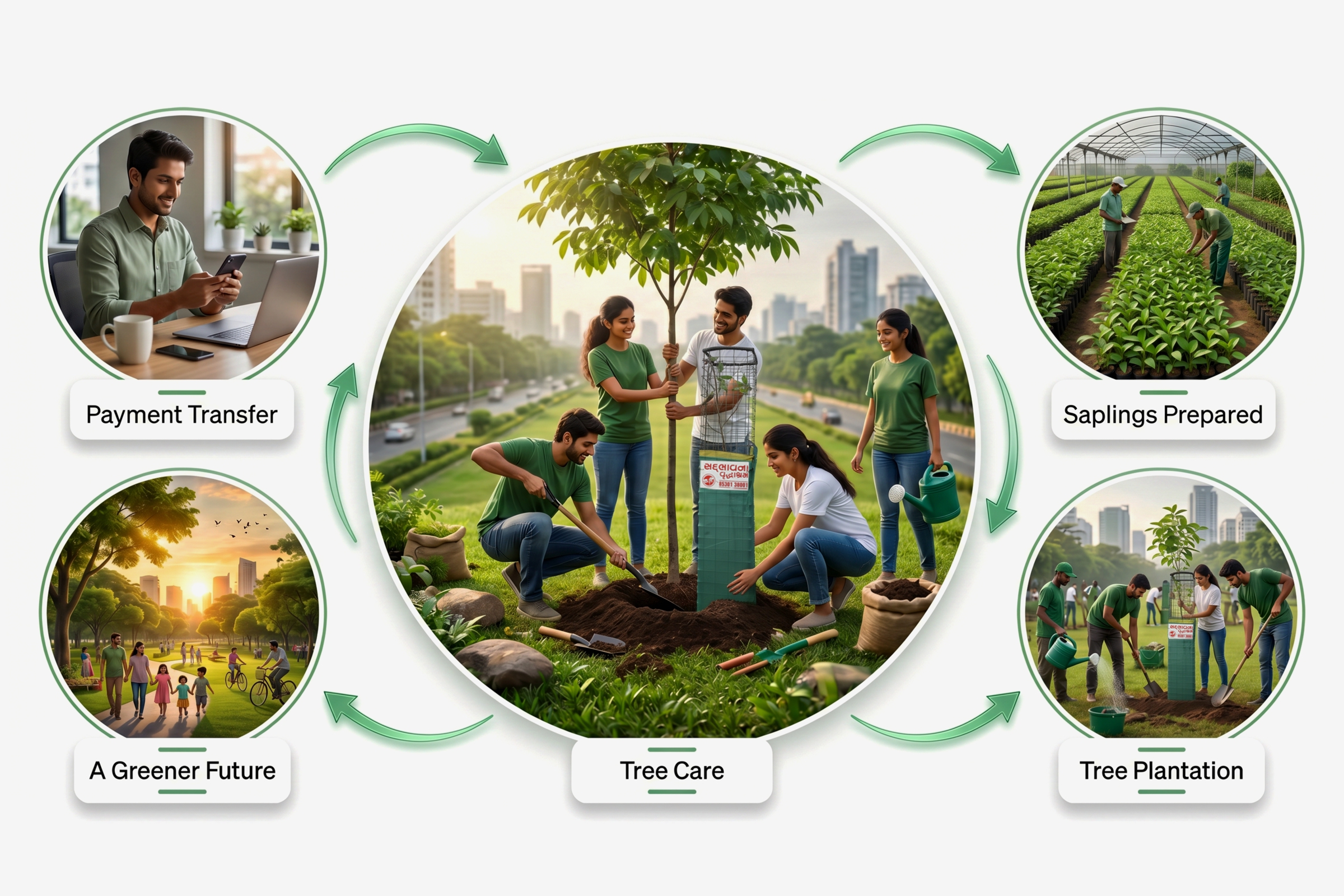
It is not necessary to pay everything to give back to the planet. You can deduct donations to approved funds, charitable institutions, and relief organisations under section 80G of the Income Tax Act, 1961 and reduce your taxable income and contribute to a cause that you care about. To any environmental activist, this is a win-win provision in that you not only pay less in tax, but also nature receives the support it deserves.
It is a step-by-step guide to all this: Who is eligible to claim it, the organisations that are eligible, how deductions are calculated, and how to submit your claim properly.
What Is Section 80G?
Section 80G helps taxpayers to deduct their gross total income of the contributions they make to designated funds and authorized charitable bodies. It is not directly a rebate on the amount of your tax, but it will decrease the amount of income on which you are calculated to pay tax. The less you have in taxable income the less you pay in taxes.
One notable fact: any deductions of Section 80G can only be made under the old tax regime. You are ineligible to claim this benefit in case you have chosen the new tax regime under Section 115BAC.
Who Claims Section 80G?
It is a broadly eligibility provision. A deduction under Section 80G can be claimed by any of the following:
- People (even Non-Resident Indians)
- Hindu Undivided Families (HUFs).
- Companies and firms
- Any other individual who is filing taxes in India.
- It is not limited in terms of age, income level, or career. You can claim it as long as you are a taxpayer in the old regime and you donate to a qualifying organisation.
Mode of Payment: What Counts and What Does Not.
Not all donations are eligible, whether the cause is good or bad. The payment method is a big issue.
The accepted modes are cheque, demand draft and cash- however, the limit on cash donations is 2000. Any cash donation above ₹2,000 does not qualify for deduction under Section 80G. Any sums exceeding this limit should be paid by any of the non-cash options like NEFT, UPI, or demand draft.
Also critical: in-kind donations, such as food, clothes, drugs, materials, are not eligible, no matter how valuable they are. Monetary contributions are the only ones that are counted, as clearly indicated in the section under Explanation 5.
Giving to Nature: What Organisations are Eligible?
As an environmentally conscious donor, there are a number of government-developed funds, which take care of nature as well as the people, which would be considered under Section 80G. Two of the most immediately pertinent are:
Swachh Bharat Kosh – This fund was established by the Central Government and it helps in funding cleanliness and sanitation projects in India. The deduction of donations is 100 percent with no qualifying limit which applies in FY 2014-15. That amount, however, is not qualifying, in the event you are making the donation as a company in your Corporate Social Responsibility (CSR) efforts as required under Section 135 of the Companies Act, 2013.
Clean Ganga Fund – This fund is also established by the Central Government and it helps in restoring and conserving the Ganga river ecosystem. Resident donors can claim a 100% deduction without any qualifying limit, from FY 2014-15. The same CSR exclusion would be relevant here also.
In addition to these, there are additional causes relating to environmental and general welfare which can be donated to any fund or institution which is accepted under the Section 80G(5). These are organisations involved in wildlife conservation, forestry, pollution control and water conservation, so long as they have a valid 80G certificate issued by the Income Tax Department.
Knowing the Four Categories of Deduction.
Section 80G does not apply equally to all donations. It is divided into four different categories, and the classification of what type to use in relation to your selected organisation clearly defines the extent of the deductions you can make.
1. 100% Deduction No Qualifying Limitation.
These are the most advantageous donations – the full amount of the donation is deductible and there is no maximum limit. Popular ones are the Prime Ministers National Relief Fund (PMNRF), PM CARES Fund, National Defence Fund, Swachh Bharat Kosh, Clean Ganga Fund, National Children Fund, National Sports Fund, National Cultural Fund, and National Illness Assistance Fund among others.
The Swachh Bharat Kosh and Clean Ganga Fund, are within the scope of environmental donors in particular. Assuming that you contribute 100,000 (Rs 1,00,000) to either of them, you will reduce the income by 1,00,000.
2. 50% Deduction No Qualifying Limit.
There is only a single fund that is in this category at the present the Prime Minister’s Drought Relief Fund. You can deduct 50% of your donation with no cap on the donation amount.
3. 100% Deduction with 10% Qualifying Limit.
Donations in this category get a full deduction, but only up to 10% of your Adjusted Gross Total Income (AGTI). The qualifying examples in this case are those involving donations to the Government or authorized local authorities to promote family planning and services donations by companies to the Indian Olympic Association or to sports bodies notified to spend the funds on development of infrastructure.
4. 50% Deduction, subject to 10% Qualifying Limit.
It is by far the most prevalent category and has the broadest scope of NGOs and charitable organisations, such as most environmental and conservation organisations registered under Section 80G(5). 50% of your donation is deductible, limited to the 10% AGTI limit.
To illustrate, when you contribute to a registered wildlife conservation NGO in this category 10,000 INR, you can claim a deduction of 5000 INR – as long as it is within your qualifying limit.
What Is Adjusted Gross Total Income (AGTI)?
The qualifying limit in categories 3 and 4 is calculated as 10% of your AGTI. AGTI can be computed in the following way:
- Begin with your Gross Total Income and then subtract:
- Any deduction in Sections 80C to 80U (except Section 80G per se)
- Exempt income
- Long-term capital gains
- Section 111A: short-term capital gains.
- Income referred to under Sections 115A, 115AB, 115AC, 115AD, and 115D
- The resultant number is your AGTI. One-tenth of this is your qualifying limit – the largest donation you can deduce under 3 and 4 combined.
Your Deduction
These are the steps to follow so that you can get your right deduction:
Step 1: Determine your gross total income without Chapter VI-A deductions.
Step 2: Take away all the deductions (except 80G) and incomes that are not counted to get your AGTI.
Step 3: Compute 10% of AGTI- this is your qualifying limit.
Step 4: Organize your donations into above four categories.
Step 5: No restriction on 1 or 2 categories and full deduction.
Step 6: In category 3 and 4: The total eligible donation is limited to the lesser of actual donations, or 10% of AGTI. Use 100% deduction donations before using the rest of the balance at 50 and then 100 percent deduction.
Step 7: Sum it all the deductions made in Steps 5 and 6 – your total deductions under Section 80G.
Section 80G Claiming in your ITR.
To claim the deduction you must have the deduction properly reported in your Income Tax Return. The following is what you require:
Paperwork to prepare:
- A receipt with the donee organisation stamped with your name, address, amount donated and PAN of the trust.
- The registration number of the organisation (80G).
- Non-cash bank records.
Information to be filled in your ITR:
You can log into the Income Tax e-filing portal and, choosing your ITR form (ITR-1 or ITR-2 in the case of most salaried individuals), go to Schedule 80G and fill out the information. Confirm and send prior to the deadline, usually July 31.
Checking Organisation 80G Status.
Always ensure that the NGO or environmental charity has their 80G approval before giving them any donations. In Section 80G(5), it is mandatory that an organisation be approved by the Principal Commissioner or Commissioner of Income Tax. The approvals are given by five years, and must be renewed.
It can be confirmed by asking for the 80G certificate of the organisation, which will include their registration number and time period. You can also use the NGO Darpan portal by the government which lets you search registered and approved organisations. Approvals are subject to change because the approvals may vary depending on the current financial year, so ensure that you confirm the approvals.
A Rapid Breviation of Section 80GGA.
Should you have an interest in scientific research or rural development – and this may involve afforestation and environmental programmes – then under Section 80GGA there is a 100% deduction of donations made to approved research associations and rural development institutions. Remarkably, this section does not have any maximum amount of deduction. The same cash limit of ₹2,000 applies. But such deduction cannot be availed to people with business or professional income and just as 80G, it cannot be availed in the new tax regime.
Conclusion
Section 80G is a useful and effective instrument to those who would like to contribute to environmental causes but would not want to shoulder the entire burden of giving. You get 100% deduction without limit by contributing to the approved funds such as Clean Ganga Fund or Swachh Bharat Kosh. Gifts to registered environmental NGOs normally belong to the category of 50% with qualifying limit, which is still a significant saving.
The trick is to ensure that an organisation is approved, and donations of over 2000 are made using a valid non-cash method, maintain a proper receipt trail and record properly in Schedule 80G of your ITR. Get it right and every rupee you spend to conserve nature has a two-fold impact; one on the planet and the other on your tax filing.