

Sadbhavna Vrudhashram’s 500 Jungle in Gujarat: Badanpur Forest Plants 10,000 Saplings in Memory of Guruji
- Today
- 10 Min Read
- 0 Comments
In a Quiet Corner of Gujarat, a Village Is Changing Its Future
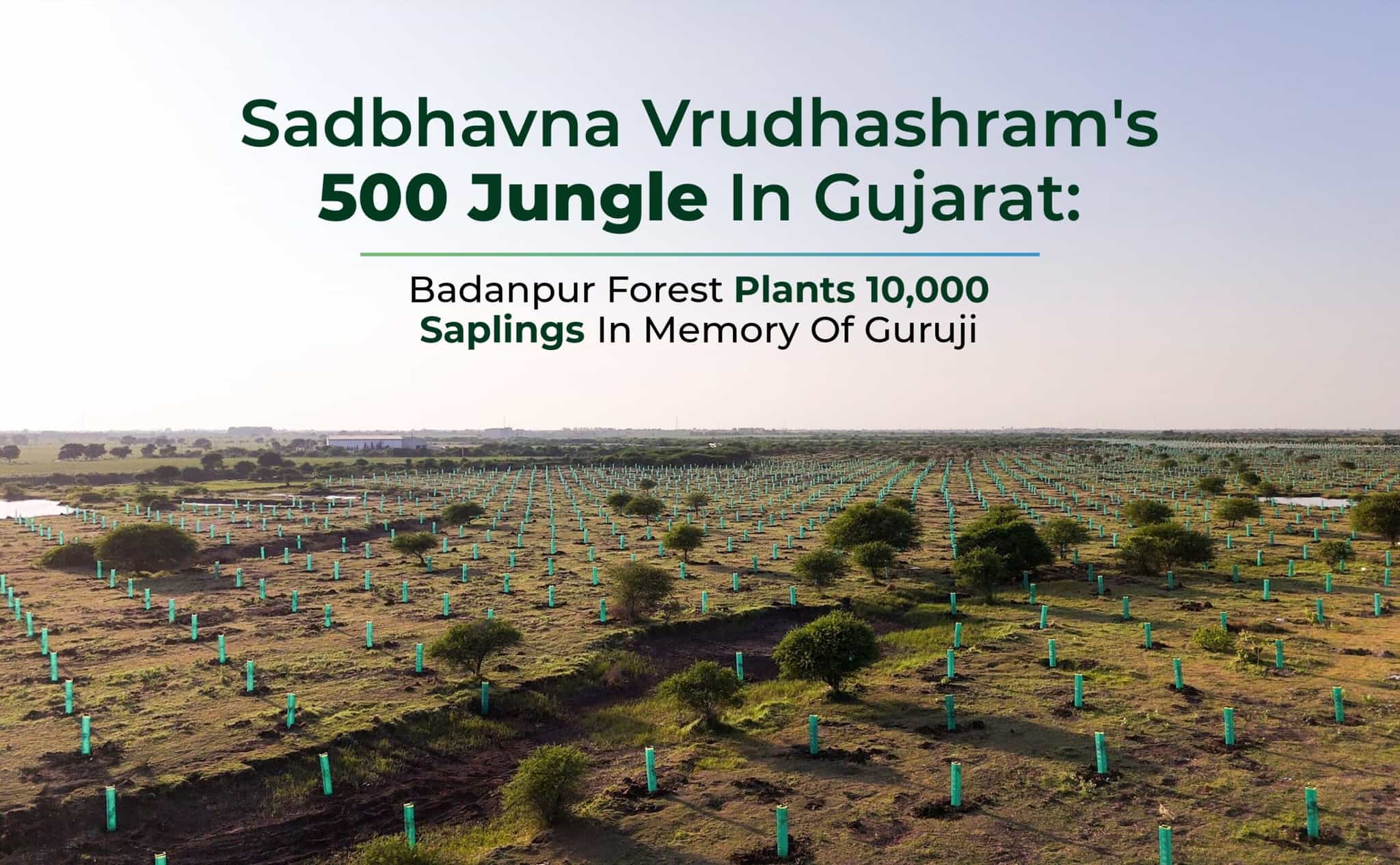
On open land at Badanpur, near Patan, more than ten thousand saplings now stand in neat rows. A few years from now, they are expected to be a dense, shaded forest.
The plantation is nearing completion. It has been made possible by the generosity of Mumbai-based Shri Jagdishbhai Vora, with the cooperation of Sadbhavna Vrudhashram. The Badanpur forest is a highlight of Sadbhavna Vrudhashram’s 500 Jungle in Gujarat initiative.
This article explains the initiative, how every tree is planted and protected, what the forest offers to people, birds and animals, and how you can take part.
Badanpur Forest at a Glance
| Detail | Information |
| Initiative | Sadbhavna Vrudhashram’s 500 Jungle in Gujarat |
| Location | Badanpur village, near Patan, Gujarat |
| Scale | More than 10,000 saplings |
| Main species | Umbro (cluster fig), Banyan, Peepal, Kadam and many others |
| Height at planting | About 4 feet |
| Planting pit | 3 feet deep, enriched with desi cow manure |
| Manure top-up | Every month |
| Structural support | 4 to 8 ft support for every sapling |
| Protection | 8 ft iron guard and mesh fencing |
| Care by | Sadbhavna Vrudhashram’s own paid staff, tractors and water tankers |
| Survival guarantee | 4 years; lost trees replaced free of cost |
| Donor updates | WhatsApp update every 3 months, regular photos, 100% documentation |
| Forest facilities | Gate, gazebo and Annakshetra for animals and birds |
| Time to dense forest | 3 to 4 years |
| Projected oxygen | About 190 tonnes |
| Projected CO₂ absorption | More than 215 tonnes |
| Expected local cooling | 2 to 3°C |
| Bird habitat potential | Lakhs of birds (at about 25 per tree) |
| Donor | Shri Jagdishbhai Vora, Mumbai |
| In memory of | Param Pujya Guruji Shri Bhanuvijay Maharaj Saheb |
| Status | Nearly complete; public inauguration soon |
What Is the 500 Jungle in Gujarat Initiative?
Sadbhavna Vrudhashram’s 500 Jungle in Gujarat initiative aims to bring forests to many parts of the state, one community at a time. Each forest is a planned plantation: useful trees, planted at a meaningful height, with a donor, an organising partner and the local village working together.
The Badanpur forest is one such forest, and a highlight of the initiative. It shows how the larger goal can be reached village by village, forest by forest.
What is the 500 jungle in Gujarat?
Sadbhavna Vrudhashram’s ‘500 jungle in Gujarat’ project is to bring forests to many places all over Gujarat, one community at a time. Every forest is a managed plantation, with trees planted at a purposeful height and with the involvement of a donor, an organising partner and local villagers.
The Badanpur forest is one such forest, and is a highlight of the initiative. It demonstrates the possibility of achieving the larger goal, one village, one forest at a time.
A forest that lives thanks to ‘How Sadbhavna Vrudhashram’.
It is very simple to plant a tree. The difficult part is keeping it alive. Many plantation drives never go beyond the planting and taking the picture stage. Badanpur is a Sadbhavna Vrudhashram which takes care of the entire process from soil testing to years of regular care. Here is how:
1. Soil testing first. Prior to planting, the soil is tested to determine what the land can support and how to prepare it.
2. A well nourished, deep hole. A 3-feet deep pit is filled with desi cow manure (chaniyu khaatar) and each tree is planted in it. This natural fertiliser will be applied once a month and will provide the roots with a constant supply of nutrients to support strong and healthy growth throughout the year.
3. Structural support from day one. When the saplings are planted, they are provided with 4-8 ft of structure. This maintains its straightness and stability during this critical period of early growth.
4. 8ft iron guard and 8ft mesh fence. Each sapling is additionally covered with iron guard (8ft in length) and mesh fencing. This protects it from cattle, stray animals and accidental damage, the leading causes of young tree death in open farm land.
5. Continuous watering and upkeep. Each tree is watered and cared for by dedicated staff and lives long after the planting day is over.
6. A real workforce. Sadbhavna Vrudhashram works with a fleet of 4,000+ paid staff and 700+ tractors and water tankers that work continuously on plantation and upkeep. This is professional, consistent care by its own team, not a one-day volunteer drive.
Full Transparency for Every Donor
Every plantation is backed by accountability:
- 100% documentation of each plantation.
- Regular photo updates, so donors can see exactly where their contribution goes and how it grows.
- A WhatsApp update every 3 months, so donors are never left wondering.
- A 4-year survival guarantee. If a tree is lost, it is replaced free of cost, so donors never lose their impact.
For Shri Jagdishbhai Vora and every future donor, this means the gift becomes a living forest, tracked and protected, and not just a ceremony.
More Than Trees: Gate, Gazebo and Annakshetra
The Badanpur forest is designed as a complete place, not just a field of trees. It includes:
- A gate, giving the forest a proper entrance and a sense of identity.
- A gazebo, a shaded place where visitors can sit, rest and enjoy the forest.
- An Annakshetra for animals and birds, a feeding point meant to serve lakhs of animals and birds that will come to live in and around the forest.
Together, these turn the plantation into a living sanctuary. People can visit and sit under the trees, and animals and birds have shelter and food in one place.
A Track Record Behind Every Tree
Sadbhavna Vrudhashram is not new in this work. After 11 years of continuous efforts, it has already planted 11,151,530+ trees (around 1.1 crore trees). It continues to work towards a larger vision of 150 crore trees across India.
The reason why guards are placed on each Badanpur tree is because of this experience, as well as fertiliser, water and a written guarantee. It has been tried and tested and is used for over 10 years.
A Forest Born from a Teacher’s Memory
This forest is the memorial of Param Pujya Guruji Shri Bhanuvijay Maharaj Saheb, who is still alive in the Sagodia area near Patan. They there have retained his memory with reverence.
Guruji used to say many times, “All the material that we receive in our life comes from nature. It is then not a favour to nature that you are giving back. It is a duty.
This forest is this duty fulfilled. A lot of memorials are constructed in stone. This one is created from living trees which will provide shade, clean air and shelter well after the planting day has passed.
What Trees are planted at Badanpur?
The plantation is home to trees synonymous with service to the land and its people:
Umbro (cluster fig): favorite tree of Indian tradition and a source of fruit for birds and animals.
Banyan (Vad): a tree with deep shade and many species that grows widely.
A long-lived tree revered across Indian culture and having a dense canopy is called Peepal.
Kadam: A fast growing tree with a wide-spreading canopy, suitable for shade.
The forest is truly more productive and resilient with many other species planted.
The importance of planting at 4 feet tall
Each tree was planted when it was already about four feet tall. Typically, most plantations are started with small seedlings which will not provide substantial shade for years.
The deep pit and monthly manure, plus the protective guards and four years of care, is why in only three or four years the project anticipates a dense, shady forest.
Expected Benefits of the Badanpur Forest
The following are estimates of the mature age of the trees.
1. Cleaner air. The grown trees will be capable of releasing around 190 tonnes of oxygen and sequestering over 215 tonnes of carbon dioxide.
2. A more moderate climate at home. The forest is anticipated to reduce the temperature by 2-3 degrees in Badanpur and the nearby villages which is a boon for farmers, children and elderly people.
3. Protection for the soil. The roots will help to hold soil firmly during monsoons and minimise erosion. Water will percolate and not wash away the soil.
4. Better water retention. For agricultural villages, it is the water-holding healthy soil that is most important.
5. A place for birds and animals to live. This is described in the next section.
A Sanctuary for Birds and Animals
If each tree hosts an average of 25 birds, the plantation could become a natural home for lakhs of birds. A quiet farm field could turn into a large sanctuary, with birdsong at every sunrise.
With the Annakshetra providing food, the forest becomes a dependable refuge. It also supports insects, pollinators and small wildlife, which strengthens the whole local ecosystem and helps nearby farms too.
Strength in Partnership
- The donor, Shri Jagdishbhai Vora: his contribution made the plantation possible.
- Sadbhavna Vrudhashram: it carries out the work from soil testing to planting to four years of care, with its own staff, tractors and water tankers.
- The Gram Panchayat: according to the donor, it made each step smoother.
Thanking everyone involved, Jagdishbhai Vora said he was sincerely grateful to the Gram Panchayat, which supported him just as fully from the beginning of the project to its end.
A Model for Other Villages in Gujarat
Projects like this show how community-based forestry can work. A donor provides resources, Sadbhavna Vrudhashram provides expertise, workforce and long-term care, and the village provides land and goodwill. Each contributes something the others cannot.
Other villages and donors can follow the same approach: test the soil first, plant tall trees in deep, enriched pits, protect each tree with a guard, commit to years of care, and keep donors informed with regular updates.
Plant One Tree Before You Leave
The forest will soon be dedicated to society at an inauguration ceremony. Organisers have invited the public to see the forest for themselves, with one request: plant at least one tree before you leave.
A single tree can shade an entire family, shelter hundreds of birds and keep the air clean for generations. By offering even one tree to nature, our own lives become more meaningful and fulfilled.
Frequently Asked Questions
What is the 500 Jungle in Gujarat initiative?
It is Sadbhavna Vrudhashram’s initiative to create forests across Gujarat. The Badanpur forest near Patan is one of its highlight projects.
What does Sadbhavna Vrudhashram do at Badanpur?
It handles the whole process: soil testing, planting in 3-feet deep pits with desi cow manure, 8 ft iron guards and mesh fencing, regular watering, monthly manure and four years of care.
Is there a survival guarantee for the trees?
Yes. Sadbhavna Vrudhashram offers a 4-year survival guarantee. If a tree is lost, it is replaced free of cost.
How do donors get updates?
Donors receive a WhatsApp update every 3 months and regular photo updates, backed by 100% documentation.
How are the trees protected from animals?
Every sapling has an 8 ft iron guard and mesh fencing, which shields it from cattle, stray animals and accidental damage.
What fertiliser is used?
Desi cow manure (chaniyu khaatar) is placed in the 3-feet deep planting pit and applied again every month.
What facilities does the Badanpur forest have?
A gate, a gazebo and an Annakshetra for animals and birds.
How many trees has Sadbhavna Vrudhashram planted?
In 11 years it has planted 11,151,530+ trees, working towards a vision of 150 crore trees across India.
Why was the forest created?
In memory of Param Pujya Guruji Shri Bhanuvijay Maharaj Saheb, who taught that giving back to nature is a duty, not a favour.
Which trees are planted there?
Umbro, Banyan, Peepal, Kadam and many other species.
How long will the forest take to grow?
A dense, shaded forest is expected in three to four years.
What environmental benefits are expected?
Projected benefits include about 190 tonnes of oxygen, more than 215 tonnes of carbon dioxide absorption, 2 to 3°C of local cooling, reduced soil erosion and habitat for lakhs of birds.
Where is Badanpur?
Badanpur is a village near Patan in north Gujarat, close to the Sagodia area.
Can the public visit?
Yes. A public inauguration is planned soon, and visitors are invited to plant one tree before they leave.