

Donate a Tree: How One Tree Can Offset Carbon Emissions for 150 Years – The Science Behind Your Environmental Donation
- Today
- 5 Min Read
- 0 Comments
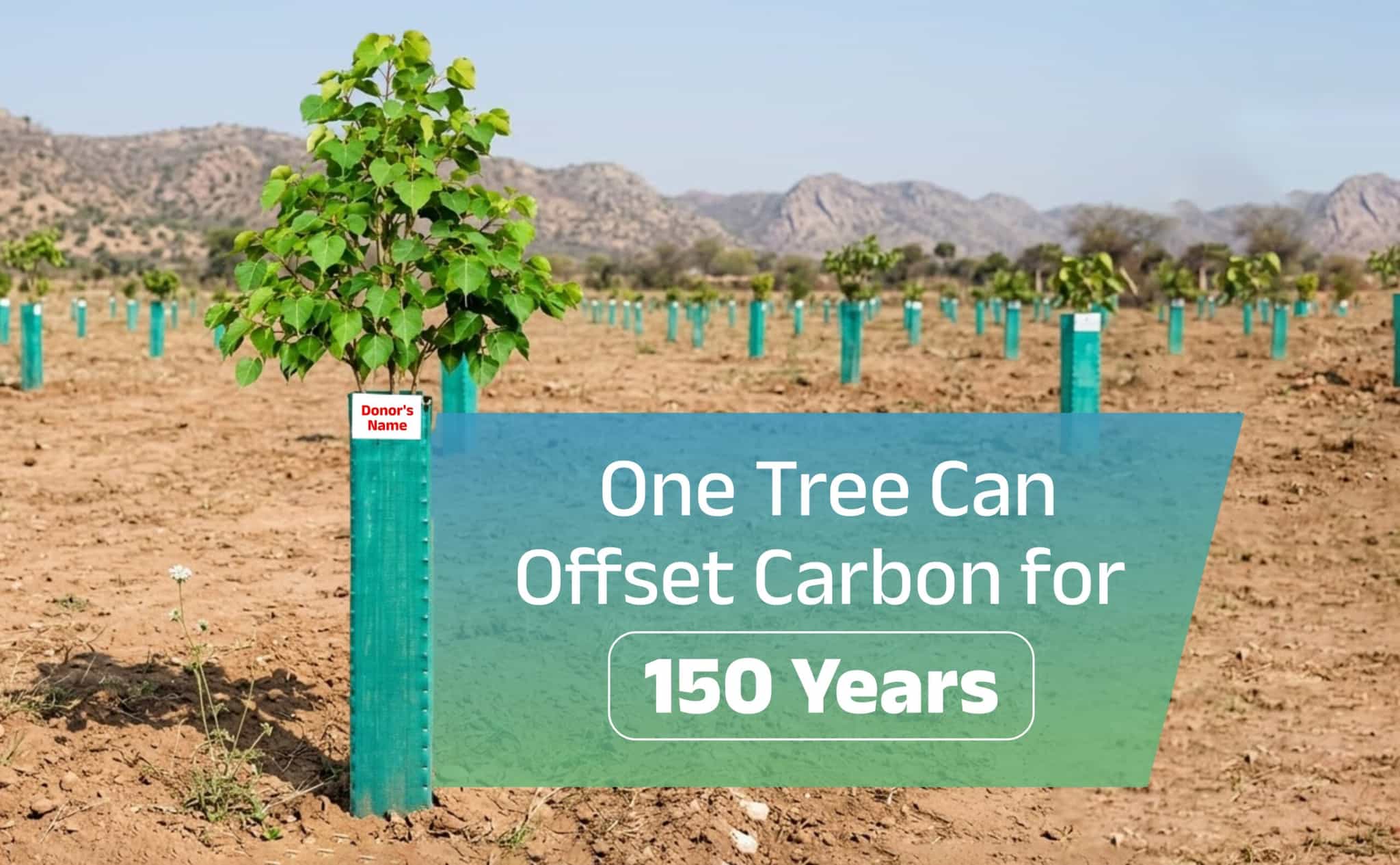
A single tree can live for well over a century, pulling carbon dioxide out of the air every year of its life. That long lifespan is why more people are choosing to donate a tree instead of relying only on personal cutbacks. This article explains how much carbon one tree can store, what it can and cannot offset, and how to make sure your environmental donation actually grows into a healthy tree.
In this article
- Why Carbon Emissions Need Lasting Climate Change Solutions
- How a Single Tree Captures Carbon
- The 150-Year Math: What One Tree Really Offsets
- How Many Trees Do We Need? Tree Plantation at Scale
- Why You Should Donate to Plant Trees, Not Just Plant Them
- How to Choose a Trustworthy Environmental Donation
- Trees Are One of Many Climate Change Solutions
- Conclusion: Donate a Tree Today
- Reference
Why Carbon Emissions Need Lasting Climate Change Solutions
Carbon dioxide is the main greenhouse gas behind global warming. The Global Carbon Project estimates that the world will emit about 40 billion metric tons of CO₂ in 2022. Fossil fuels, deforestation and heavy industry produce most of it.
Cutting emissions comes first, but it is not enough on its own. We also need ways to remove the CO₂ that is already in the atmosphere. Trees do this naturally, which makes tree plantation one of the most affordable and scalable climate change solutions available to ordinary people. Our tree plantation method shows how this works on the ground
How a Single Tree Captures Carbon
During photosynthesis, a tree absorbs CO₂ and converts it into wood, leaves, roots and soil carbon. The amount it stores depends on four things:
- Species: fast-growing trees absorb quickly, while slow-growing hardwoods store carbon for longer.
- Age: young trees grow fast, but mature trees hold far more carbon overall.
- Climate: tropical forests generally sequester more than cold-climate forests.
- Soil quality: rich soil supports faster growth and more underground carbon.
A commonly cited figure from the USDA Forest Service is that a mature tree absorbs about 22 kg (48 lbs) of CO₂ per year. The Arbor Day Foundation estimates about one ton over a 40-year lifespan. Tropical trees in ideal conditions can absorb around 50 kg per year, according to IPCC data.
The 150-Year Math: What One Tree Really Offsets {#the-150-year-math}
Many trees live for a century or more, so the benefit of one tree is slow and steady, not instant. Using the average rate of 22 kg per year:
| Tree lifespan | Estimated CO₂ stored |
| 40 years | about 0.9 tons |
| 100 years | about 2.2 tons |
| 150 years | about 3.3 tons |
These are illustrative figures based on a constant average rate. Real growth is uneven, and young trees absorb less in their first years.
The average person emits about 4.5 tons of CO₂ per year, according to Our World in Data. So one tree over 150 years offsets less than a single year of one person’s emissions. The long lifespan is still valuable, but a tree works best as part of a larger effort, not as a one-for-one cancellation of your footprint.
How Many Trees Do We Need? Tree Plantation at Scale
At 22 kg per tree per year, absorbing all 40 billion tons of annual emissions would take about 1.8 trillion trees. Here is what the same rate means for individuals and countries:
- One person: roughly 205 trees to cover one year of emissions.
- India (about 2.8 billion tons): roughly 127 billion trees.
- United States (about 5 billion tons): roughly 227 billion trees.
- China (about 10 billion tons): roughly 454 billion trees.
Earth has about 3 trillion trees today, and about 15 billion are cut down every year. Protecting existing forests matters as much as planting new ones. You can see how this is done in practice on our tree plantation projects page.
Why You Should Donate to Plant Trees, Not Just Plant Them
Planting a sapling is a good gesture, but survival is what produces the carbon benefit. Many saplings die from poor species choice, lack of water, grazing or no follow-up care. When you donate to plant trees through an organisation with field teams, your money covers:
- The right species for the local soil and rainfall.
- Planting and aftercare, including watering and protection.
- Monitoring, so trees survive long enough to store carbon.
- Local livelihoods, because community involvement protects forests over time.
If you prefer a more personal route, you can adopt a tree and follow its growth. Businesses can do the same at scale through CSR plantation projects.
How to Choose a Trustworthy Environmental Donation {#how-to-choose-a-trustworthy-environmental-donation}
Before you make an environmental donation, look for these signs of a reliable organisation:
- Transparent survival rates. Ask how survival is measured and reported.
- Tree tracking. Geo-tagging lets you track your tree after planting.
- Native, suitable species instead of a single fast-growing monoculture.
- Proper registration. In India, check for 12A and 80G status if you want a tax benefit.
- Honest claims. Be cautious of anyone who says one tree cancels a lifetime of emissions.
You can also support the work without donating money. Volunteer with us or bring a plantation drive to your campus through our school activities.
Trees Are One of Many Climate Change Solutions {#trees-are-one-of-many-climate-change-solutions}
Trees cannot solve the problem alone, because the scale of emissions is too large. The strongest approach combines several climate change solutions:
- Renewable energy to cut emissions at the source.
- Forest and soil protection to keep stored carbon in place.
- Better farming practices that build carbon in the soil.
- Ocean-based and technological options, such as kelp farming and direct air capture.
Tree plantation fits into this mix because it is low-cost, scalable and good for biodiversity, water and local communities. For more guides like this one, browse our blog.
Conclusion: Donate a Tree Today {#conclusion-donate-a-tree-today}
One tree will not erase your carbon emissions, but over 100 years or more it quietly removes a meaningful amount of CO₂ while supporting wildlife, soil and people. Multiply that by thousands of well-cared-for trees and the effect becomes real.
If you want to contribute, donate to plant trees with a transparent organisation and pair it with lower emissions in your own life. Have questions about how your donation is used? Contact us.Every donation of a tree is a long-term investment in a cooler planet.
Reference:
CATCH Foundation – How Many Trees Do We Need to Offset Carbon Emissions? A Data-Driven Answer