

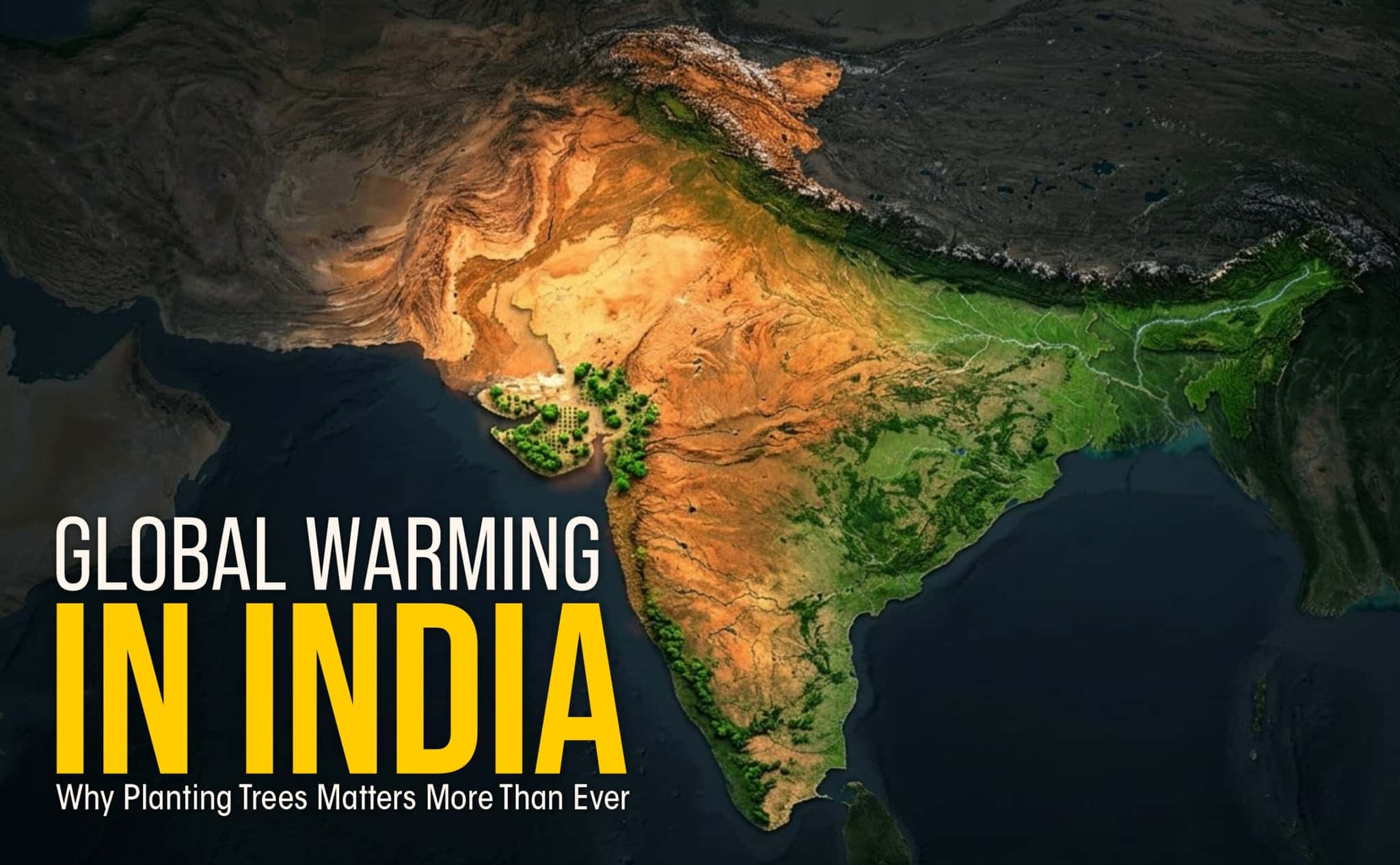
Introduction: The Seasons Have Lost Their Rhythm
Have you noticed that no seasons feel accurate anymore? Rain arrives in the middle of winter.Summer heat lingers deep into autumn.Sometimes you can feel two or three seasons in a single day. This is no coincidence. It is the everyday face of global warming in India, and it is a problem every one of us is facing at the same time.
People talk about it constantly: how it changes the seasons, harms our health, damages our food and disturbs daily life. But very few people stop to ask the more important question: what is the real, practical solution? This blog explains the problem, the causes, the effects, and a solution that begins with one simple pledge: “Let’s give something back to the Earth.
What Is Global Warming and Why Should India Worry?
Global Warming refers to overall increase in the Earth’s average temperature, primarily due to the accumulation of heat-trapping gases in the Earth’s atmosphere. The Earth has over 8 billion people and India alone has over 1.4 billion. These are so many people living in limited land and resources that even if there is a little increase in temperature it makes a huge difference.
Why India Is Especially Vulnerable
India is a country with a long coastline and a large farming population, a growing urban population with cities and rivers relying on monsoon rains and the Himalayan glaciers. This makes the country very vulnerable to heat waves, floods, drought and irregular rainfall.
Major Causes of Climate Change in India
If you want to solve the problem, you need to understand the reasons behind climate change. Human activities are the primary causes of:
1. Burning Fossil Fuels
Coal, petrol and diesel for electricity generation, transport and industry are sources of carbon dioxide (CO2), one of the largest sources of warming.
2. Deforestation and Loss of Green Cover
Carbon dioxide is absorbed by trees. Forests that are lost are roads, buildings and farmland and the carbon stored in the forests goes back into the air and nature is no longer the natural air cleaner.
3. The rapid growth of urban population and pollution
The urban heat islands are the effect of concrete cities capturing the heat. Vehicle smoke, factory emissions and burning of waste add to the problem.
4. Agriculture and Waste
Livestock, rice fields and garbage dumps are also major sources of the greenhouse gas methane.
Impact of Global Warming in India.Consequences of Global Warming in India.
Global warming in India has become a reality. They can be seen at our homes, hospitals, farms and markets.
Inconsistent weather patterns.Unpredictable weather patterns.
Winters are increasingly brief and mild, summers increasingly longer and more extreme and rainfall is now occurring late, early or in torrents. Seasonal variations which farmers and families relied on for generations are being destroyed.
Impact on Human Health
Warm and wet weather increases the risk of heat stroke, dehydration, breathing difficulties and diseases like dengue fever and malaria. Air quality is a contributing factor to asthma and heart issues.
Impact on Food and Farming
Inconsistent weather and extreme temperatures result in lower yields, higher food costs and stress for farmers. Irrigation is becoming more difficult each year due to water scarcity.
Rising Seas, Floods and Droughts
India experiences extreme weather; there are flash floods in one part and severe drought in the other. Sea level rise poses a risk to coastal communities and mangrove ecosystems.
Why Talking Is Not Enough: We Need Real Solutions
We discuss global warming at dinner tables, on social media and in news debates. But awareness without action changes nothing. The good news is that one of the most effective solutions is also the simplest and cheapest: plant trees.
Planting Trees to Reduce Global Warming
Planting trees to reduce global warming works because trees are natural carbon capture machines. Through photosynthesis they take in CO2 and release oxygen, storing carbon in their trunks, branches, roots and the soil around them.
The Importance of Tree Plantation
The importance of tree plantation goes far beyond carbon:
- Cleaner air: trees filter dust and pollutants.
- Cooler surroundings: shade and evapotranspiration can lower local temperatures, especially in cities.
- Water security: roots help rainwater soak into the ground and recharge groundwater.
- Healthy soil: roots prevent erosion and keep land fertile.
- Biodiversity: trees give homes and food to birds, insects and animals.
- Mental wellbeing: green spaces reduce stress and improve quality of life.
Where India Stands Today
According to the India State of Forest Report 2023, India’s total forest and tree cover is about 25.17% of its geographical area, a rise of 1,445 sq km since 2021. That is encouraging progress, yet the National Forest Policy sets a goal of 33% green cover, so there is still a long way to go. Every new tree helps close that gap.
Environmental Protection in India: Government and Community Efforts
Effective environmental protection in India needs both policy and people. Government programmes, forest departments, NGOs and schools are working on afforestation, mangrove protection, clean energy and waste management. But laws and projects alone cannot succeed unless ordinary citizens join in. This is where families come in.
Join the Sadbhavna Tree Plantation Initiative: 150 Crore Trees for a Greener India
One of the boldest examples of planting trees to reduce global warming comes from Rajkot, Gujarat, where Sadbhavna Vruddhashram has announced a nationwide drive to plant 150 crore trees across India. The goal is to make the entire country green, and it needs every one of us to help complete it.
Who Is Behind the Initiative?
Sadbhavna Vruddhashram is an old age home and charitable organization in Rajkot. Shri Vijay Dobariya, the founder of the organisation, states that it has planted and nurtured approximately 1.10 crore trees in the past ten years. This comprises of 40 lakh trees under protection and 70 lakh trees cultivated using the Miyawaki forest methodology.
The Pledge: Complete the Journey of 150 Crore Trees
The next is significantly larger. The commitment is to plant and retain more than 150 crores of trees across India, of which more than 15 crores are to be planted and retained in Gujarat. The first phase aims to plant 3 crores trees and 150 forests are to be planted in Gujarat, with the help of the government, institutions, donors, volunteers and companies.
As the advisor of this initiative we can say “Planting is easy, caring is difficult”, as Shri Mital Khetani says. That’s why this pledge concentrates on growing and protecting all trees, not just the digging of the pit.
How You Can Join the Initiative
- Take the pledge: commit to plant and nurture at least one tree with your family.
- Volunteer: join local plantation drives in your city, village, school or society.
- Donate or sponsor: support saplings, tree guards and watering for a forest near you.
- Partner as an organisation: schools, companies and institutions can adopt a plantation site.
- Share the mission: tell friends and relatives so the 150 crore target becomes a people’s movement.
Together, one pledge at a time, we can complete the promise of a greener India and make a real contribution to environmental protection in India.
One Family, One Pledge: Small Actions, Huge Difference
The World’s population is greater than 8 billion people and India has more than 1.4 billion. What if every family member made a commitment to do some kind of a contribution to the Earth? The country would have hundreds of millions of trees with only one tree per household.
The following are some simple ways to begin today:
- Plant a native tree in your home, farm, school or society like neem, banyan, peepal, mango or jamun.
- Take care of it: water it, keep it safe and observe it growing. A planted tree is not as important as a tree that lives!
- Celebrate with Trees: Plant 1 Tree on Birthdays, Anniversary and Festivals.
- Reduce energy and water use at home to reduce carbon footprint.
- Always use public transport, cycle or car pool where possible.
- Minimize plastic and waste and compost kitchen scraps.
Share the pledge: encourage neighbours, friends, and children to share their pledge. Frequently Asked Questions
How does global warming affect India’s seasons?
It shifts rainfall patterns, lengthens summers, shortens winters and causes unseasonal rain, so seasons overlap and feel unpredictable.
How many trees should a family plant?
Start with at least one native tree per family member, and focus on keeping each one alive.
Can planting trees alone stop global warming?
No. Trees are a powerful part of the solution, but they work best alongside reduced emissions, clean energy and sustainable living.
Conclusion: Give Something Back to the Earth
Global warming in India is not an imaginary, unseen or unchanging phenomenon; it is real, visible and is increasing. The solutions to climate change can be human made, and the causes are human-made. Trees are easy to plant, inexpensive and something that any family can do. Let’s give something back to the Earth; one person, one family, one tree at a time, let’s make the pledge today.
Call to action: Take the pledge, plant a tree this week, and share this blog to inspire others.